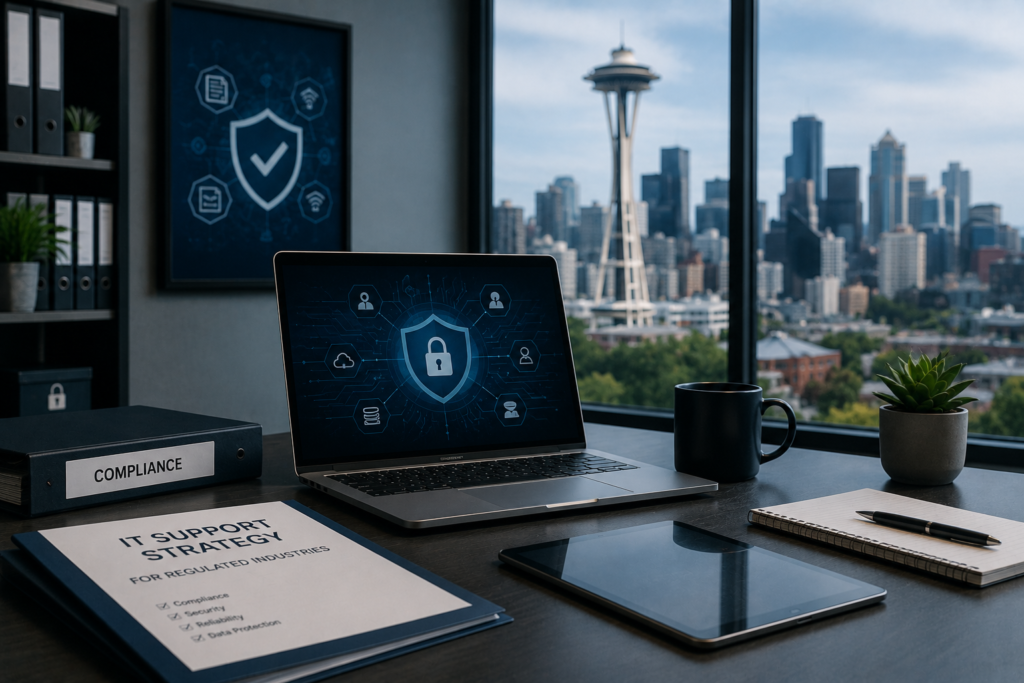
The short answer
Cyber Security for small businesses in Seattle in 2026 means layered, proactive protection across your endpoints, email, cloud tools, and people. It is not a product you buy once. Ransomware, phishing, and credential theft are increasingly targeting small and mid-sized Seattle businesses, and the cost of an incident for a business without proper defenses typically runs into tens of thousands of dollars in recovery, lost productivity, and reputational damage. This guide tells you what real protection looks like, what threats you are actually facing, and how to evaluate cybersecurity companies in Seattle.
Key Takeaways
- Seattle small businesses are actively targeted by cybercriminals. Attackers deliberately pursue smaller organizations because they are far less likely to have layered defenses in place.
- Antivirus software alone does not constitute a cyber security program. Modern attacks bypass traditional antivirus regularly. Layered protection is the only effective model.
- Your employees are the most targeted point in your security posture. Phishing and social engineering are the leading entry vectors for breaches across every industry.
- Cyber security consulting in Seattle should be built into your managed IT plan, not sold as a premium add-on. If it is an add-on, the base plan does not protect you.
- Local cyber security companies in Seattle understand Washington state compliance requirements and can respond on-site when an incident requires physical presence.
Where to Find Cyber Security Seattle Providers That Actually Protect You
Most business owners think about cyber security the way they think about insurance: it matters, but it is easy to push to the back of the priority list. That calculus changes quickly after an incident.
A ransomware attack does not just encrypt your files. It shuts down your operations, potentially for days. A data breach does not just expose records. It triggers notification obligations, potential fines under Washington state law, and reputational damage that can cost you clients. For businesses in regulated industries including healthcare, law, and finance, the compliance consequences compound on top of the operational ones.
Seattle computer security is not a technology problem. It is a business continuity problem, and the businesses that treat it that way are significantly better positioned to survive an attack than those that treat it as a checkbox.
What Real Cyber Security Protection Looks Like for Seattle Businesses

Modern cyber security relies on layered protection across endpoints, email, cloud systems, and users.
Real IT security in Seattle is not a single product. It is a layered approach where multiple controls work together to reduce risk. Here is what a mature cyber security program covers:
1. Endpoint Detection and Response (EDR):
Traditional antivirus looks for known threats. EDR monitors device behavior in real time and catches threats that antivirus misses, including zero-day attacks and fileless malware.
2. Email Security and Anti-Phishing
According to the Verizon 2024 Data Breach Investigations Report, phishing and social engineering remain the leading initial access vectors across business email attacks (verizon.com/dbir). Proper email security includes phishing and impersonation protection, link scanning, and attachment sandboxing, not just a spam filter.
3. Multi-Factor Authentication (MFA)
Compromised credentials are the primary driver of account takeovers, according to Microsoft’s 2024 Digital Defense Report (microsoft.com/security/blog), MFA stops an attacker from accessing your systems even if they have a valid username and password.
4. Security Awareness Training
Your employees are the most targeted point in your security posture. Regular, engaging security training dramatically reduces the likelihood that a phishing email leads to a breach.
5. Dark Web Monitoring
According to SpyCloud’s 2025 Annual Identity Exposure Report,3.1 billion exposed passwords were recaptured in 2024 alone, a 125% increase from the previous year, with 44.8 billion total PII records circulating in criminal underground markets. Dark web monitoring alerts you when credentials associated with your business surface in those markets before attackers can use them.
6. Incident Response Planning
When an attack happens, and statistically it will, the businesses that recover fastest are the ones that had a documented response plan before the attack. This includes who to call, what to isolate, how to communicate, and how to restore operations.
7. Backup and Disaster Recovery
A proper backup strategy is the last line of defense against ransomware. Backups need to be regular, tested, and stored in a way that an attacker cannot encrypt along with your primary data.
This is the foundation. Any cyber security provider missing multiple items from this list is not offering a complete program, regardless of what their website says.
The Cyber Security Threats Seattle Businesses Face Most Often
Understanding your actual threat landscape helps you prioritize where to focus your defenses. These are the attacks IT security firms in Seattle see most frequently targeting local businesses:
Phishing and Business Email Compromise
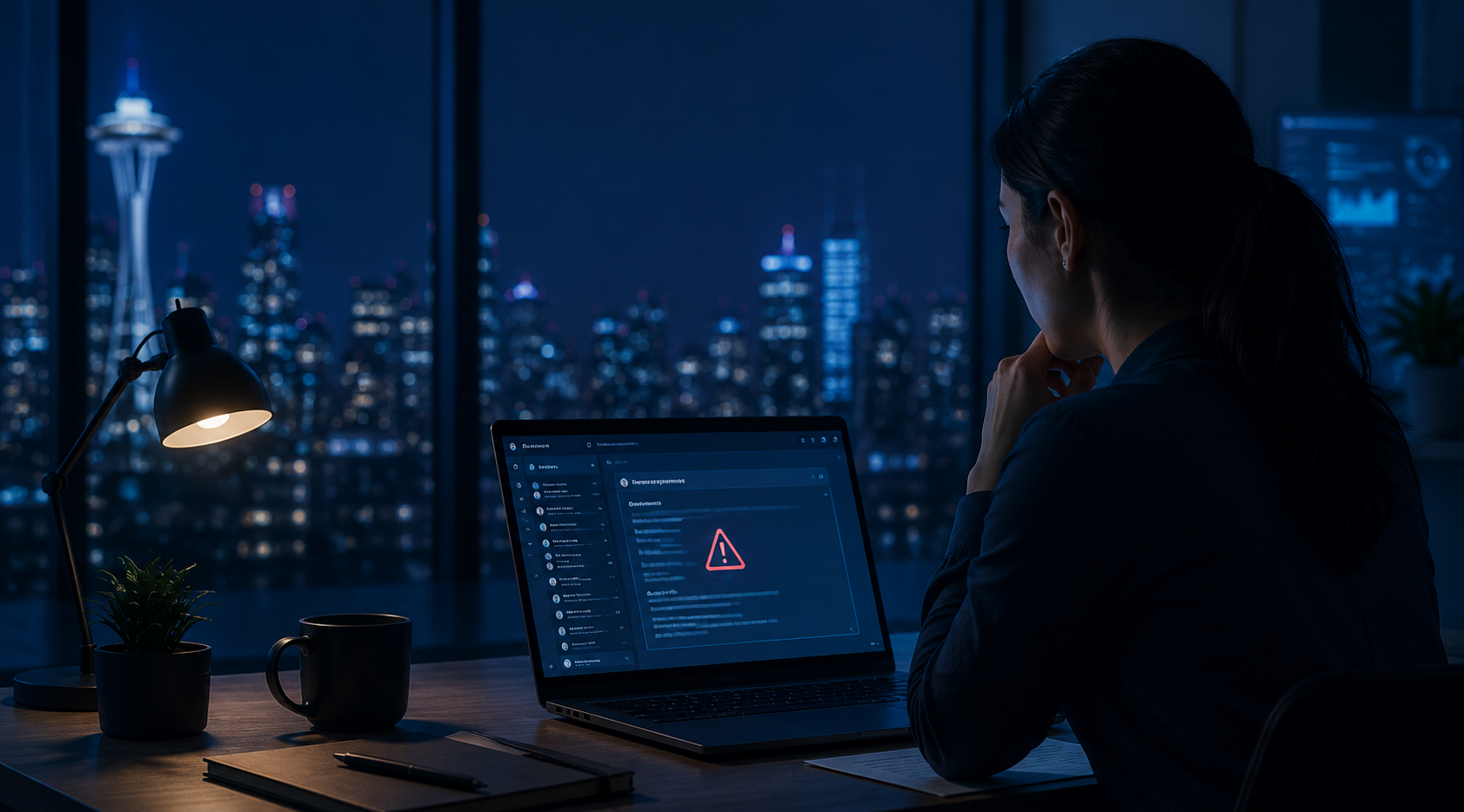
Phishing remains one of the most common entry points for cyberattacks targeting small businesses.
Business email compromise, where attackers impersonate executives or vendors to authorize fraudulent payments, was the second highest-dollar cybercrime category in the United States in 2024, accounting for $2.77 billion in losses according to the FBI’s 2024 Internet Crime Report (ic3.gov). Professional services businesses are disproportionately targeted.
Ransomware
Ransomware encrypts your files and demands payment for the decryption key. Modern ransomware operations also steal data before encrypting it, creating a double extortion threat where paying the ransom does not guarantee your data stays private.
Credential Stuffing and Account Takeover
Using stolen username and password combinations from previous breaches, attackers attempt to access business accounts at scale. Microsoft 365 and cloud applications are primary targets for this type of attack.
Supply Chain Attacks
Attackers compromise a vendor or software provider to gain access to their customers. This is increasingly common and particularly difficult to defend against without active visibility into your full software environment.
Insider Threats
Not all threats are external. Disgruntled employees, accidental data exposure, and poor access control practices all create risk from inside your organization. Proper access management and offboarding procedures are the primary controls here.
Compliance and Cyber Security in Seattle: What Regulated Industries Need to Know
For businesses in regulated industries, cyber security consulting in Seattle is a compliance necessity, not just a security one. It is about demonstrating compliance to auditors, clients, and regulators. Working with a cyber security consulting seattle firm that understands regulated environments means your defenses and your documentation are built together. Here is what the major frameworks require at a high level:
- HIPAA (Healthcare): Technical safeguards including access controls, encryption, audit logs, and an incident response capability. Healthcare organizations and their vendors handling patient data must comply.
- SOC 2 (Technology and Professional Services): Demonstrates to clients that your systems are secured and your data handling practices meet a defined standard. Increasingly required by enterprise clients before they will sign contracts.
- CMMC (Defense Contractors): Businesses working with the Department of Defense must meet Cyber security Maturity Model Certification requirements, which range from basic cyber hygiene to advanced security practices.
- Washington State My Health My Data Act: Washington’s data privacy law has significant implications for businesses handling health-adjacent consumer data, with requirements that go beyond HIPAA in certain areas.
Maxwell IT builds compliance requirements into the IT and security plans for every client in regulated industries across Seattle and the surrounding area. If you are not sure where your business stands on compliance, a security assessment is the right starting point.
Essential Cyber Security Services Every Managed IT Provider Should Offer

A documented cyber security strategy significantly reduces ransomware risk.
Not all IT security in Seattle is created equal. When evaluating cyber security consulting firms in Seattle, the starting point is understanding what should be included by default versus what is a legitimate add-on versus what should make you question whether the provider is serious about security at all.
These cyber security services should be foundational to any managed IT plan:
Endpoint Detection and Response (EDR): Goes beyond antivirus to monitor device behavior in real time. Should be deployed on every workstation, laptop, and server.
Email Security: Filters phishing attempts, malicious attachments, and spoofed sender addresses before they reach your employees. This is where most attacks start.
Multi-Factor Authentication (MFA) Enforcement: Requires a second verification step beyond a password. Should be enforced across all accounts and business applications, not just email.
Security Awareness Training: Regular simulated phishing tests and training for employees. People are the most targeted point in any organization’s security posture.
Patch Management: Ensures operating systems and software are updated on a consistent schedule to close known vulnerabilities.
Dark Web Monitoring: Monitors for compromised credentials associated with your business domain and alerts you before attackers can use them.
Backup and Disaster Recovery: A tested, documented recovery plan with backups stored separately from your primary systems.
Incident Response Planning: A documented process for identifying, containing, and recovering from a security incident. Businesses without one recover significantly more slowly and at higher cost.
If any of these are listed as premium add-ons by a prospective provider, that is a sign their base plan was designed to look affordable on a comparison sheet, not to actually protect your business.
Where to Find Reputable IT Security Providers in Seattle That Also Handle IT
One of the most common questions business owners ask is where to find cyber security companies in Seattle that genuinely understand the full scope of protection, not just providers who add the word to their website. Here is a practical approach:
Ask for a security assessment before you commit: Any reputable cyber security consulting firm in Seattle should be willing to assess your current environment before you sign a contract. If they skip straight to the proposal without understanding your current state, that is a red flag.
Look for framework alignment: Ask whether the provider follows the NIST Cyber security Framework or a comparable standard. Providers who cannot reference a recognized framework are typically building security programs on intuition rather than methodology.
Check for industry-specific experience: A firm that has worked with healthcare organizations understands HIPAA. A firm that has worked with government contractors understands CMMC. General IT experience and compliance-specific experience are not the same thing.
Ask about their own security practices: A managed IT provider handling your sensitive data should be able to explain how they protect it. Ask about their SOC 2 compliance status, their employee security training, and how they handle access to client systems.
Get references from similar businesses: Ask to speak with current clients in your industry and of similar size. First-hand accounts from businesses like yours are more reliable than any sales conversation.
Maxwell IT operates as both a managed IT provider and a cyber security consulting firm in Seattle, serving businesses across engineering, law, manufacturing, professional services, software tech, and nonprofits. Cyber security is built into every client engagement, not bolted on afterward.
Ransomware Prevention Checklist for Seattle Businesses
Use this checklist to evaluate your current ransomware readiness:
- Endpoint detection and response software deployed on all devices
- Email security with phishing and impersonation protection enabled
- Multi-factor authentication enforced on all accounts and applications
- Employees trained on phishing recognition within the last 12 months
- Software patches and updates applied within 30 days of release
- Backups tested for recovery within the last 90 days
- Backups stored in an isolated location separate from primary systems
- Incident response plan documented, reviewed, and tested
- Dark web monitoring active for business credentials
- Administrative privileges limited to only those who need them
If your business cannot check most of these boxes today, your risk exposure is higher than it should be. This is exactly where working with a cyber security consulting firm in Seattle makes a measurable difference.
What to Ask When Evaluating Cyber Security Firms in Seattle
What Framework Do You Follow?
Any serious IT security firm in Seattle should be able to reference a recognized framework such as the NIST Cyber Security Framework and explain how their services map to it. IT security Seattle providers who cannot speak to a structured methodology are building programs on intuition rather than proven standards.
What Is Included in Your Base Cyber Security Plan?
Basic protections should be included by default, not sold as add-ons. If endpoint protection, email security, and MFA enforcement are all line items on a quote, that is a pricing model designed to minimize what you are comparing, not to protect your business.
How Do You Handle Incident Response?
Your provider should have a documented process for identifying, containing, and recovering from a security incident. Ask for specifics: who do you call, what is the response time, and how do you communicate with affected parties?
Can You Support Our Compliance Requirements?
If your business has specific compliance obligations, confirm your provider has direct experience with those frameworks. General IT experience and compliance experience are not the same thing.
Do You Offer Security Awareness Training?
Employee training is one of the most effective tools in the cyber security toolkit. A provider that does not include it is leaving one of your biggest vulnerabilities unaddressed.
Frequently Asked Questions
How Much Does Cyber Security Cost for a Small Business in Seattle?
Cyber security services are typically bundled into a managed IT services plan priced per user per month. According to CompTIA’s IT Industry Outlook, managed IT services for Seattle businesses generally range from $100 to $250 or more per user per month depending on scope. The better comparison is that fee versus the average cost of a ransomware incident or data breach, which consistently runs into tens of thousands of dollars for small businesses.
What Is the Most Common Cyber Security Threat Targeting Seattle Small Businesses?
Phishing is the most common entry point. Business email compromise, where attackers impersonate executives or vendors to authorize fraudulent payments, is the highest-dollar cybercrime category in the United States according to the FBI’s 2024 Internet Crime Report (ic3.gov). Professional services businesses are disproportionately targeted.
What Are the Essential Cyber Security Services Offered by Managed IT Providers?
At minimum, a managed IT provider should include endpoint detection and response, email security, multi-factor authentication enforcement, security awareness training, patch management, dark web monitoring, backup and disaster recovery, and a documented incident response plan. Any provider that charges extra for most of these items is not offering a true cyber security program.
How Do I Find Reputable IT Firms with 24/7 Support and Cyber Security for Small Businesses?
Look for managed IT providers who include both 24/7 monitoring and cyber security in their base plan, have written SLA response time commitments, and can provide references from businesses of similar size and industry. Local Seattle-based providers are generally preferable because they can respond on-site when needed and understand Washington state compliance requirements.
Does My Seattle Business Need a Cyber Security Assessment?
If you are not sure whether your current protections are adequate, the answer is almost certainly yes. A cyber security assessment gives you a clear picture of your risk exposure, identifies gaps in your defenses, and provides a prioritized roadmap for addressing them. Maxwell IT offers a free assessment for Seattle-area businesses.
Is Antivirus Enough to Protect My Business?
No. Traditional antivirus detects known threats by signature. Modern attacks, including fileless malware and zero-day exploits, frequently bypass antivirus entirely. A complete security posture requires endpoint detection and response, email security, MFA, employee training, dark web monitoring, and backup working together.
What Cyber Security Services Does Maxwell IT Offer in Seattle?
Maxwell IT provides a full cyber security program including endpoint detection and response, email security, multi-factor authentication, security awareness training, dark web monitoring, backup and disaster recovery, and incident response planning. For businesses with compliance obligations, we provide support for frameworks including HIPAA, SOC 2, and CMMC. Washington state data privacy requirements, including the My Health My Data Act, may apply depending on the type of business and data handled. Cybersecurity is built into every managed IT engagement, not sold as a separate add-on.
Is Your Seattle Business Protected? Find Out Today.
Most businesses do not find out they had a security gap until after it is exploited. A free cyber security assessment from Maxwell IT gives you a clear, honest picture of your current defenses, where the gaps are, and what it would take to close them. No jargon, no pressure, just a straightforward evaluation from a Seattle-based team that works with businesses like yours every day.
Request Your Free Cyber Security Assessment: https://www.maxwellit.com/contact
Last updated: June 2, 2026