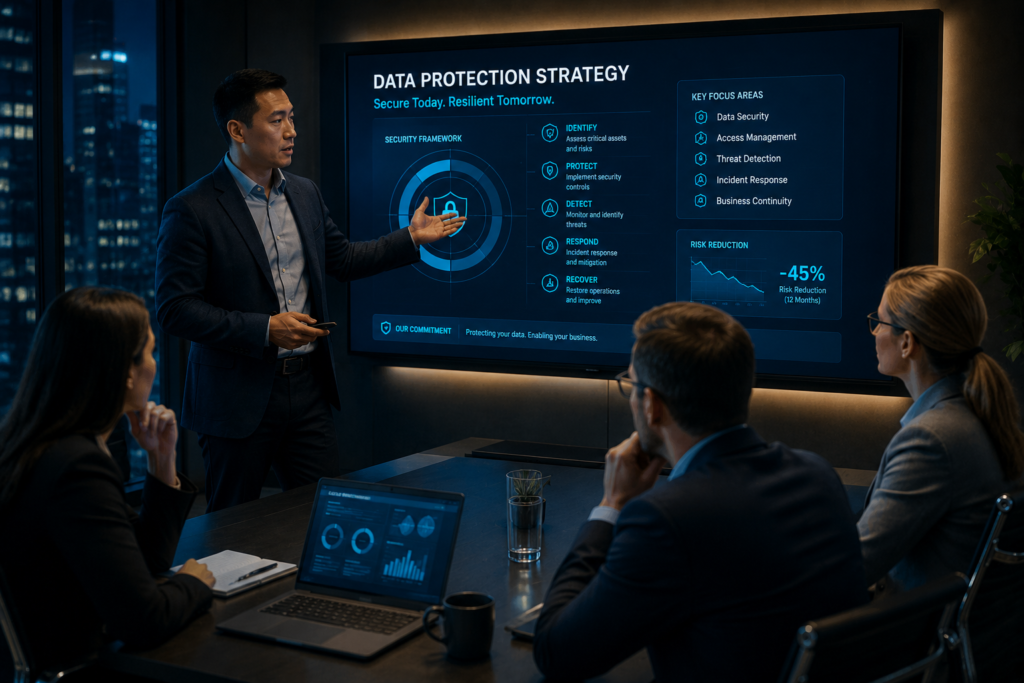
The short answer: Cybersecurity consulting Seattle is not a one-time purchase or an annual review. It is a continuous advisory relationship that keeps your defenses ahead of threats, ensures your data can be recovered if an attack succeeds, and adapts as your business grows. This guide explains what real cybersecurity consulting covers, how managed service providers handle data backup and disaster recovery, and what to demand from any Seattle cybersecurity company before you sign.
Key Takeaways
- Cybersecurity consulting and buying security software are not the same thing. Software is a tool. Consulting is the ongoing strategy that ensures all the tools work together and evolve as threats change.
- Data backup and disaster recovery is a cybersecurity function. A business that cannot recover quickly from an attack has not finished its security program regardless of how strong its defenses are on paper.
- Seattle cybersecurity companies vary widely in depth and scope. Knowing how to evaluate what you are being sold separates genuine protection from marketing language.
- MSP IT packages for startups should include both protection and recovery. A security package with no tested recovery capability is incomplete by definition.
- A cybersecurity program without a tested recovery capability is not a complete program. Businesses with strong perimeter defenses but untested backups face the same multi-week shutdowns as businesses with weaker defenses when an attack gets through.
- The average cost of a ransomware incident for a small business far exceeds the annual cost of a managed IT plan with cybersecurity built in. Prevention consistently delivers better financial outcomes than recovery.
What Cybersecurity Consulting Seattle Actually Covers
The distinction between buying security software and engaging a cybersecurity consulting firm in Seattle is one of the most important clarifications a small business owner can make before evaluating providers.
Security software is a product. You purchase it, deploy it, and it operates within its designed parameters. Antivirus, firewalls, and basic email filters are products.
Cybersecurity consulting is a service. A cybersecurity consultant in Seattle assesses your current IT environment, identifies the gaps between your existing defenses and the threats your business actually faces, builds a prioritized plan for closing those gaps, and then monitors and adjusts that plan as both the threat landscape and your business evolve. Software is a component of that plan, not the plan itself.
For small businesses in Seattle, this distinction matters because threats change faster than individual software products can be updated to address them. A cybersecurity consulting engagement means someone with accountability for your security outcomes is actively tracking how those threats evolve and adjusting your defenses accordingly, not just renewing a subscription.
A real cybersecurity consulting engagement includes: a current-state assessment identifying gaps in coverage, configuration weaknesses, and unmanaged risk; a prioritized remediation roadmap that sequences improvements by risk level and business impact; ongoing monitoring for indicators of compromise; regular reporting that translates technical security status into business terms; and periodic strategic reviews that update the approach based on changes in both the threat landscape and your operations.
How Managed Service Providers Handle Data Backup and Disaster Recovery
This is one of the most common questions businesses ask when evaluating IT security in Seattle, and one of the most important to get a specific answer on before signing with any provider.
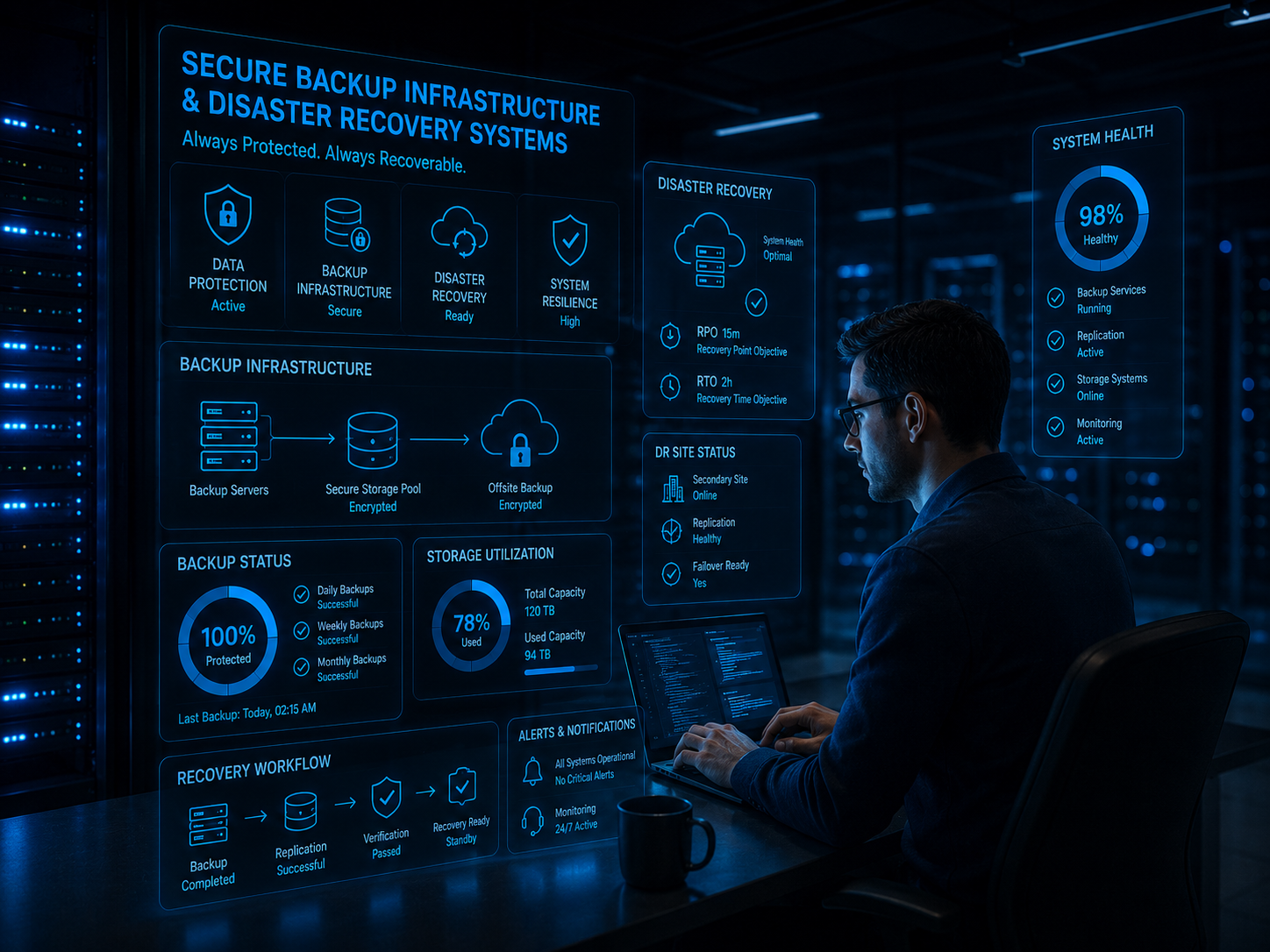
A managed backup program includes automated daily backups, recovery testing, and ransomware-resistant architecture.
Data backup and disaster recovery are related but distinct functions that are frequently conflated. Backup is the process of copying your data to a secondary location on a scheduled basis. Disaster recovery is the full capability to restore your business operations to a functional state after a failure, whether that failure results from ransomware, hardware breakdown, accidental deletion, or another cause. Backup is a component of disaster recovery, not a substitute for it.
The 3-2-1 Backup Rule
The foundation of a managed backup architecture is the 3-2-1 rule: three copies of your data, stored on two different types of media, with one copy located offsite or in a cloud environment separate from your primary systems. This architecture prevents a single event, including a ransomware attack, from destroying both your primary data and your backup simultaneously. Any cybersecurity consulting firm in Seattle that cannot describe their backup architecture in these terms is not building a recovery-capable program.
Recovery Testing
A backup that has never been tested for recovery is not a recovery capability. It is an assumption. Recovery testing confirms that data can actually be restored, that the restoration process works within your defined Recovery Time Objective, and that nothing critical is missing from the backup scope. A managed IT provider should conduct recovery tests on a documented schedule and provide confirmation of results. Ask any prospective provider when they last tested a client recovery and what the results showed.
Recovery Time and Recovery Point Objectives
Your Recovery Time Objective (RTO) is how long it takes to restore your business to operational status after a failure. Your Recovery Point Objective (RPO) is how much data you can afford to lose, measured in time. For most businesses, losing more than 24 hours of data is unacceptable; for others in regulated industries or real-time operations, the threshold is hours or less. A cybersecurity consulting engagement should document both your RTO and RPO and build your backup strategy explicitly around meeting them.
Ransomware-Resistant Backup Architecture
Modern ransomware operations frequently attempt to identify and encrypt backup systems along with primary data before executing the final attack. Backups stored in immutable cloud storage, air-gapped environments, or with write-once configurations are the primary technical defense against this tactic. Your IT security provider in Seattle should be able to explain specifically how your backups are protected from the ransomware scenarios that Seattle businesses actually face.
CISA data backup and recovery guidance for small businesses
The Real Cost of Skipping Cybersecurity Consulting
The financial case for cybersecurity consulting in Seattle becomes straightforward when the cost of an incident is considered honestly rather than abstractly.
Ransomware incidents for small businesses involve costs across several categories that compound quickly. Direct recovery costs include forensic investigation to understand how the attack gained access, system restoration from backup if a tested backup exists, ransom payment consideration if it does not, and the technical work of rebuilding compromised systems. Indirect costs include productivity loss across every person whose work was interrupted, billable hours that could not be captured during the outage, and the operational cost of communicating with affected clients and partners.
For businesses in regulated industries, a layer of compliance costs compounds on top of those: regulatory notification obligations, documentation of the incident and response, and potential exposure to fines where notification deadlines are missed or protections were demonstrably inadequate.
Businesses that had cybersecurity consulting built into their managed IT engagement consistently recover faster and at lower total cost than those that did not. The reasons are straightforward: they had tested backups, a documented incident response process, and a provider who knew exactly what to do because they had planned for this scenario in advance rather than responding to it cold.
MSP IT Packages for Startups: What to Demand at Every Price Point
When comparing MSP IT packages for startups and early-stage businesses, the temptation is to choose the lowest-cost option and add services as the company grows. This approach consistently underestimates the risk exposure that exists from the first day of operations.
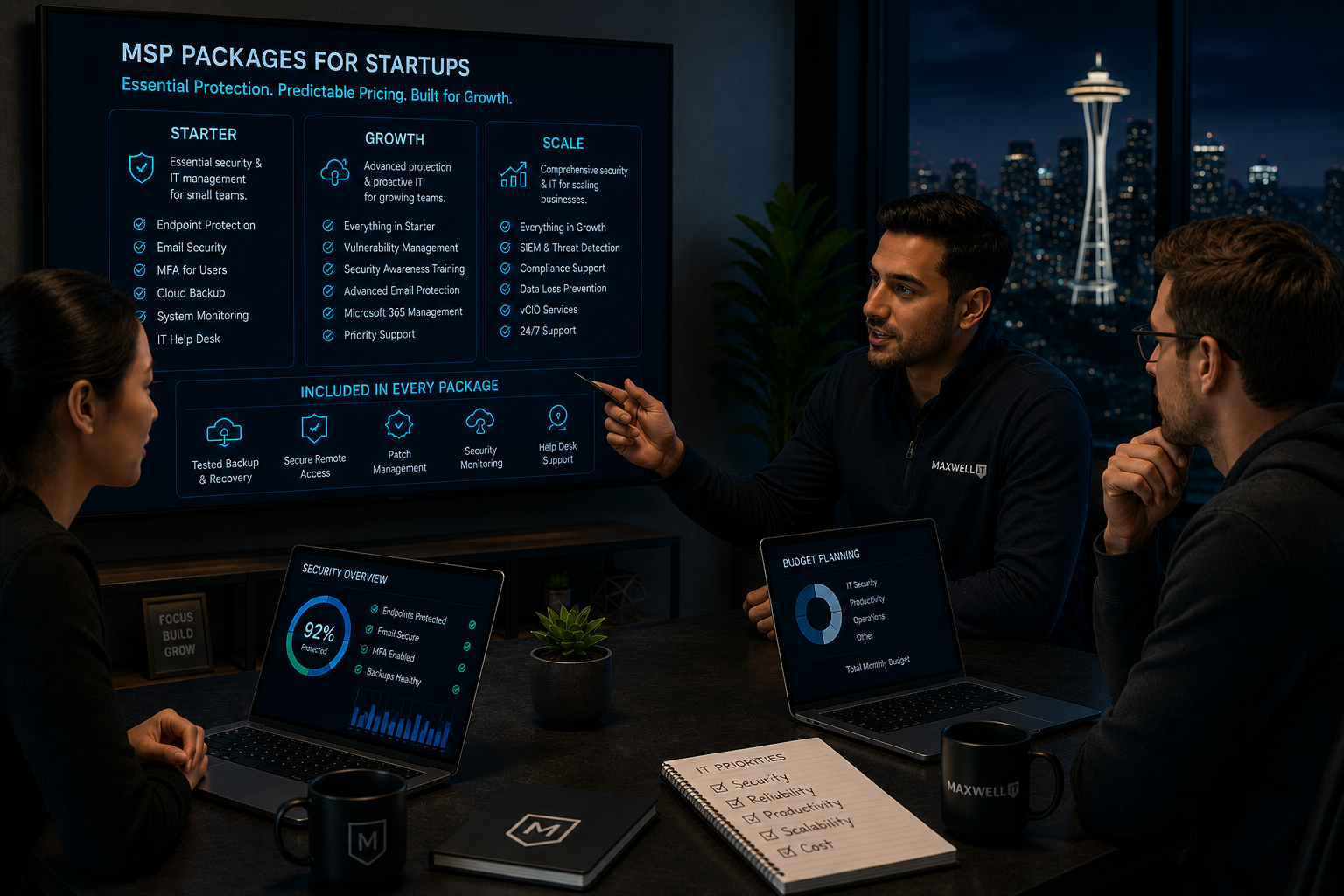
MSP IT packages for startups should include endpoint protection, email security, MFA, and tested backup as baseline requirements.
Here is what a legitimate cybersecurity package should include for a small business in Seattle at any size, and what separates a program built for protection from one priced for a comparison sheet:
- Endpoint protection with behavioral monitoring, not just signature-based antivirus. Behavioral monitoring catches threats that traditional antivirus was never built to detect.
- Email security with active filtering against phishing attempts, spoofed senders, and malicious attachments. Most successful attacks on small businesses begin in the inbox.
- Multi-factor authentication enforced across every account and application. A provider who cannot confirm MFA is deployed and enforced across your environment has left a significant credential exposure unaddressed.
- Backup architecture that is ransomware-resistant and regularly tested for verified recovery, not just scheduled to run. A backup that has never been tested for restoration is not a recovery capability.
- Patch management on a defined, managed schedule. Known unpatched vulnerabilities are among the most consistently exploited entry points in small business environments.
- Integration between security monitoring and disaster recovery. When a threat is detected, your provider should be able to move immediately into recovery procedures. Security and recovery managed as separate, disconnected services leaves a gap between detection and restoration that costs businesses days of downtime.
Any MSP IT package that lists most of these as optional add-ons has been priced for comparison purposes, not built for protection. When evaluating packages, ask specifically which of these items are included in the base price and which generate additional charges.
CISA: Phishing guidance for small and medium businesses
CISA Known Exploited Vulnerabilities Catalog
Where to Find IT Security Providers in Seattle Offering Real Cybersecurity
Evaluating Seattle cybersecurity companies requires asking questions that reveal operational depth rather than sales language. Here is a practical approach.
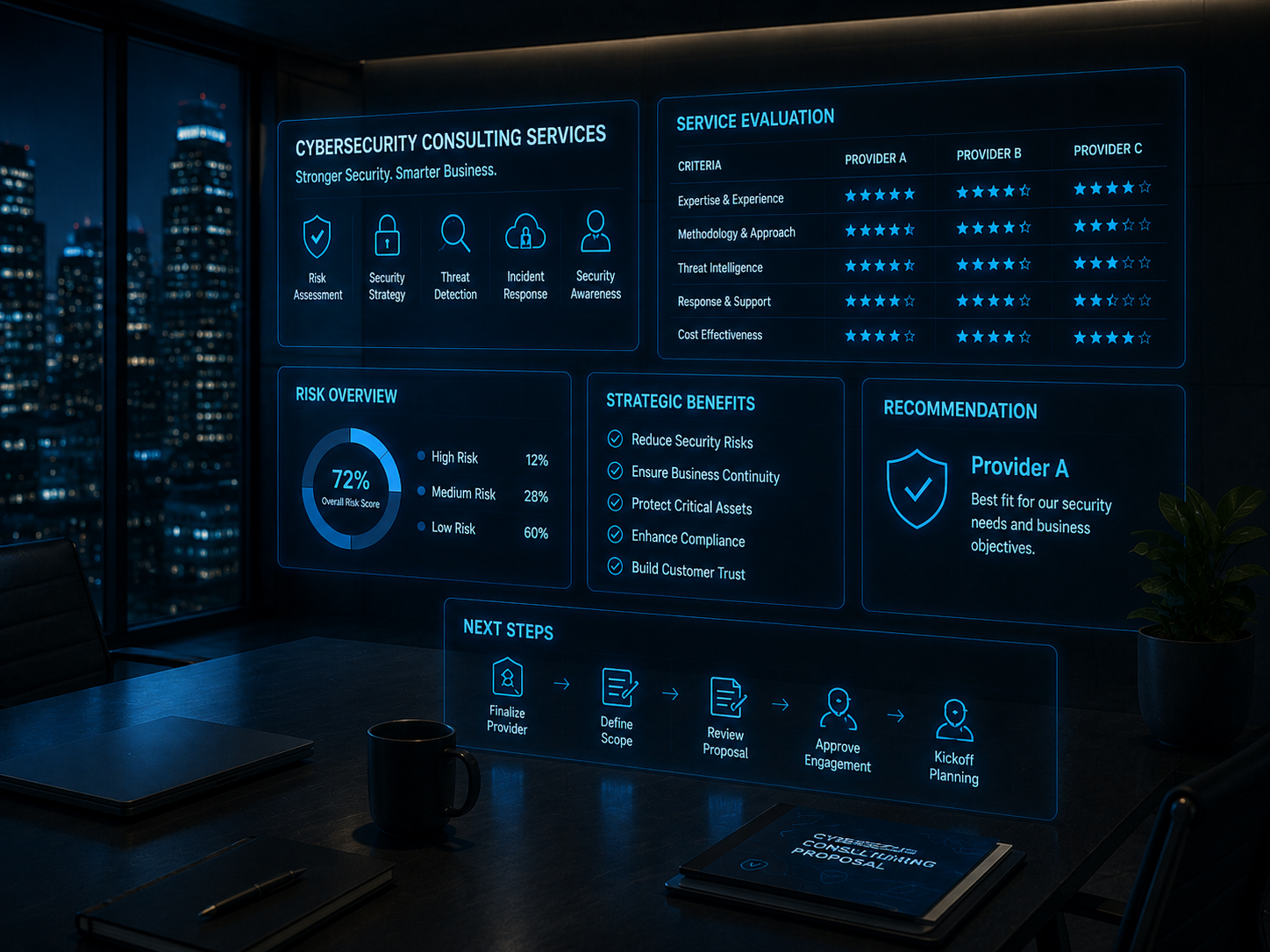
Evaluating Seattle cybersecurity companies requires asking about assessment processes, incident response, and recovery integration.
Start With Scope, Not Price
The first filter when evaluating cybersecurity companies in Seattle should be whether their base offering matches the scope of a real security program. A plan priced attractively because it excludes foundational protections is not a discount. It is a gap.
Ask How Their Security Monitoring Connects to Recovery
This is the question that most directly reveals whether a provider has built a complete program. Ask specifically: if your monitoring detects an active intrusion at 11 PM, what is the next step for recovery, and how quickly can your backup environment be engaged? A cybersecurity consulting firm in Seattle that manages security and backup separately, with no documented handoff between detection and recovery, has built two half-programs rather than one complete one.
Ask About After-Hours Incident Response
Ask specifically what happens at 10 PM on a Sunday when an alert indicates a device on your network is behaving anomalously. A cybersecurity consulting firm that cannot describe their after-hours incident response process in specific terms has not built one. How a provider responds to a real incident is the true test of their capabilities.
NIST Cybersecurity Framework overview
Look for Integration Between Security and Recovery
A provider who manages your cybersecurity separately from your backup and disaster recovery is not managing the full picture. These functions belong together because the purpose of security is not just to prevent attacks but to ensure the business survives them. Ask how the provider connects their security monitoring with their backup and recovery capabilities.
Verify Client References in Your Industry
IT security Seattle providers who regularly serve businesses in your industry understand the compliance requirements, the common attack vectors, and the specific configurations that regulated environments require. Ask for references from businesses in your specific sector and confirm their experience directly.
What to Expect From a Real Cybersecurity Consulting Engagement in Seattle
When you engage a legitimate cybersecurity consulting firm in Seattle, the onboarding process should give you a clearer picture of your actual risk than you have ever had before.
The initial assessment covers your full endpoint environment, email configuration, user access controls, backup status, patch levels, and any compliance framework gaps relevant to your industry and data handling. The output is a prioritized gap analysis that identifies what requires immediate attention, what can be phased over time, and what your current protections already have covered.
Ongoing reporting should translate security status into terms meaningful to business leadership. The number of threats blocked in a given month provides useful context. The specific open vulnerabilities in your environment and the priority sequence for closing them drives actual decisions.
Regular strategic reviews, typically on a quarterly schedule, ensure that your security posture is evaluated against both the current threat landscape and any changes in your business. A new SaaS tool, a new employee with elevated access requirements, or a new client with specific data handling requirements all carry security implications that an active consulting relationship surfaces proactively rather than reactively.
Business IT Solutions in Seattle: Putting Security and Recovery Together
The most complete business IT solutions in Seattle combine proactive security with a tested recovery capability. The goal is not only to prevent attacks but to ensure that a successful attack does not end the business.
A business that has invested in strong endpoint protection, email security, and access controls but has never tested its backup recovery is still one ransomware incident away from a multi-week operational shutdown. A business with strong backup capability but weak perimeter defenses is accepting recovery costs that should not have been incurred. The two functions belong together under a single provider who owns accountability for both.
Maxwell IT builds cybersecurity consulting programs for Seattle businesses that integrate protection and recovery into a single managed engagement. Every client program includes a security assessment, active monitoring, tested backup and disaster recovery, and the incident response capability to act immediately when something requires it. Cybersecurity is not an add-on to our managed IT plans. It is built in from day one.
Frequently Asked Questions
What does cybersecurity consulting in Seattle involve?
Cybersecurity consulting in Seattle involves assessing your current IT environment, identifying security gaps against your actual threat profile, building a prioritized remediation plan, and then monitoring and adjusting your defenses on an ongoing basis. It is not a one-time project. It is a continuous advisory relationship that ensures your security posture evolves with the threats targeting businesses in your industry.
How do managed service providers handle data backup and disaster recovery?
A managed backup and disaster recovery program includes automated backups to multiple destinations following the 3-2-1 rule, recovery testing on a documented schedule to confirm data can actually be restored, defined Recovery Time and Recovery Point Objectives, and ransomware-resistant backup architecture that stores copies separately from primary systems. The critical differentiator is testing. Backups that have never been tested for recovery are assumptions, not capabilities.
What should be included in MSP IT packages for startups?
At minimum, a startup IT security package should include endpoint protection beyond basic antivirus, email security filtering, multi-factor authentication enforcement, tested data backup with a documented recovery process, and ongoing patch management. Any of these sold as add-ons rather than base inclusions indicates a package optimized for cost comparison, not for actual protection.
How do I find reputable cybersecurity companies in Seattle?
Start by asking for a risk assessment before any proposal. Reputable Seattle cybersecurity companies assess your current state before recommending a solution. Then ask about their after-hours incident response process, how they connect security and recovery capabilities, and request references from clients in your specific industry.
What is the difference between cybersecurity consulting and managed IT security?
Cybersecurity consulting focuses on strategy, assessment, and planning: understanding your current risk, prioritizing improvements, and building the right program for your business. Managed IT security is the operational execution of that strategy, including active monitoring, threat response, and ongoing maintenance of security tools. The best outcomes come from a provider who delivers both under a single engagement.
How much does cybersecurity consulting cost for a small business in Seattle?
Cybersecurity consulting is most cost-effective when bundled into a managed IT engagement priced per user per month. The more useful comparison is consulting cost versus the average cost of a security incident. For small businesses, ransomware recovery and breach response regularly reach five-figure totals before factoring in productivity loss and regulatory exposure. Prevention consistently delivers better financial outcomes.
What is the real cost of a ransomware attack for a Seattle small business?
Ransomware incidents for small businesses involve direct recovery costs including forensic investigation and system restoration, indirect costs including productivity loss during the outage, and for regulated businesses, compliance and notification obligations. Total costs can reach or exceed five figures depending on the scope of the incident and the business’s recovery readiness. Businesses with tested backups and a documented response plan recover substantially faster and at lower cost than those without.
Does Maxwell IT offer cybersecurity consulting in Seattle?
Yes. Maxwell IT provides cybersecurity consulting built into every managed IT engagement for businesses across Seattle, Portland, and Alaska. Every program includes a security assessment, active monitoring, tested backup and disaster recovery, and incident response capability. Cybersecurity is a core component of every client plan, not an add-on.
Find Out Where Your Cybersecurity Stands Today
Most businesses do not discover how their defenses and recovery capabilities actually hold up until an incident puts them to the test. A free consultation with Maxwell IT will show you how your current security and recovery capabilities work together, where the gaps are, and what a complete cybersecurity and disaster recovery program should look like for a business your size.
Request Your Free Cybersecurity Consultation: https://www.maxwellit.com/contact
Last updated: June 26, 2026